
The Ultimate Guide to AI Resume Screening Software: How It Works & Top Tools for 2024
The hiring landscape has been fundamentally transformed. Gone are the days of recruiters manually sifting through towering stacks of paper resumes. Today, the first "reader" of your application is likely an algorithm. AI resume screening software has become the indispensable gatekeeper of modern recruitment, promising efficiency for employers and presenting a new challenge for job seekers. This guide demystifies the technology, compares the leading tools for 2024, and provides actionable strategies for both recruiters implementing the systems and candidates navigating them.
Thank you for reading this post, don't forget to subscribe!Introduction: The Rise of AI in Resume Screening
The shift from manual screening to automated efficiency has been driven by necessity. Recruiters faced with hundreds of applications for a single role needed a way to surface the most qualified candidates quickly, moving beyond a simple keyword search. This created a core problem: a disconnect in how recruiters and candidates interact with screening technology. Recruiters seek the best match, while candidates strive to be seen. This guide bridges that gap, covering how AI screening software works under the hood, evaluating the top tools on the market, and outlining proven strategies for success on both sides of the hiring process.
How AI Resume Screening Software Actually Works
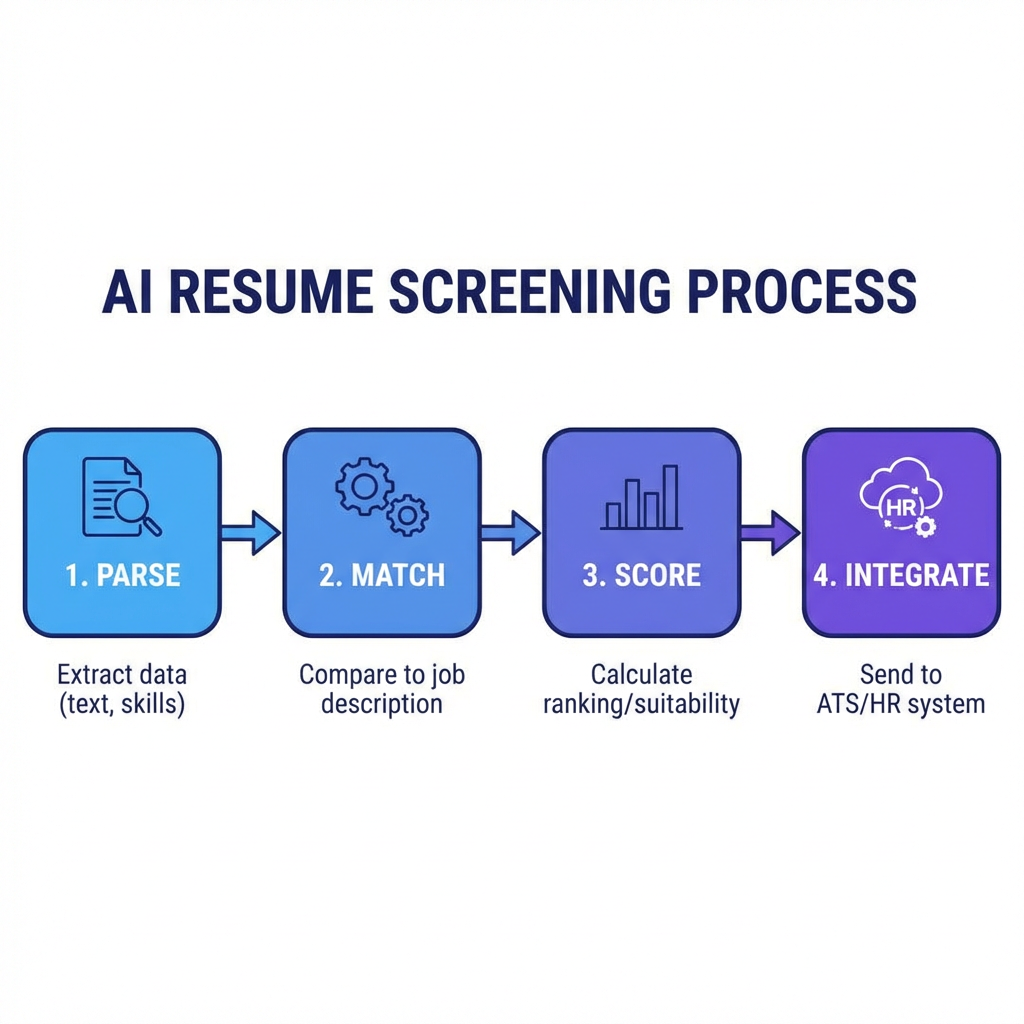
Understanding the process is key to mastering it. AI screening is not a single action but a sophisticated, multi-step pipeline.
Step 1: Parsing & Data Extraction (AI Resume Parsing). This is the foundational step. The software uses Natural Language Processing (NLP) and machine learning to "read" a resume, whether it’s a PDF, Word doc, or even a LinkedIn profile. It identifies and categorizes information—name, contact details, work experience, skills, education, and certifications—converting unstructured text into structured, searchable data. Advanced AI resume parsing software can understand context, differentiating between a company name and a job title, for instance.
Step 2: Keyword & Skill Matching Against Job Descriptions. Once parsed, the candidate’s data is compared to the job description. The AI goes beyond exact keyword matching. It uses semantic search to understand related terms and concepts (e.g., matching "Python programming" with "software development in Python"). It assesses the relevance, proficiency, and recency of skills.
Step 3: Scoring, Ranking, and Predictive Analytics. Candidates are assigned a match score or ranking based on the alignment of their profile with the job requirements. More advanced systems employ predictive analytics, using historical hiring data to identify candidates whose profiles resemble previously successful hires, potentially predicting cultural fit or longevity.
Step 4: Integration with Applicant Tracking Systems (ATS). The best automated resume screening software doesn’t operate in a vacuum. It seamlessly integrates with the company’s ATS (like Greenhouse, Lever, or Workday), automatically populating candidate records, updating statuses, and allowing recruiters to manage the entire workflow from a single platform.
Key Benefits of Implementing AI Screening Tools
The adoption of AI screening is not just a trend; it delivers tangible, strategic advantages.
Dramatic Time Savings for Recruiters and Hiring Managers. By automating the initial screening, recruiters can reduce time-to-fill by up to 75%. They can focus their human expertise on engaging with the most promising shortlisted candidates rather than administratively filtering resumes.
Reduction of Unconscious Bias in Early-Stage Screening. When configured correctly, AI can be programmed to ignore demographic information like name, gender, age, or university, focusing purely on skills and experience. This promotes a more diverse and equitable candidate shortlist, though it requires careful auditing to ensure the algorithm itself isn’t biased.
Improved Quality of Hire through Data-Driven Matching. By consistently applying the same criteria to every applicant and using data to identify top performers, companies can make more objective hiring decisions, leading to better employee performance and retention.
Scalability for High-Volume Recruitment. For organizations hiring at scale—whether for seasonal work, graduate programs, or rapid growth—AI screening is the only practical way to manage thousands of applications without compromising on quality or candidate experience.
Top AI Resume Screening Software Tools Compared
Choosing the right platform is critical. Here’s a look at some of the leading contenders in 2024.
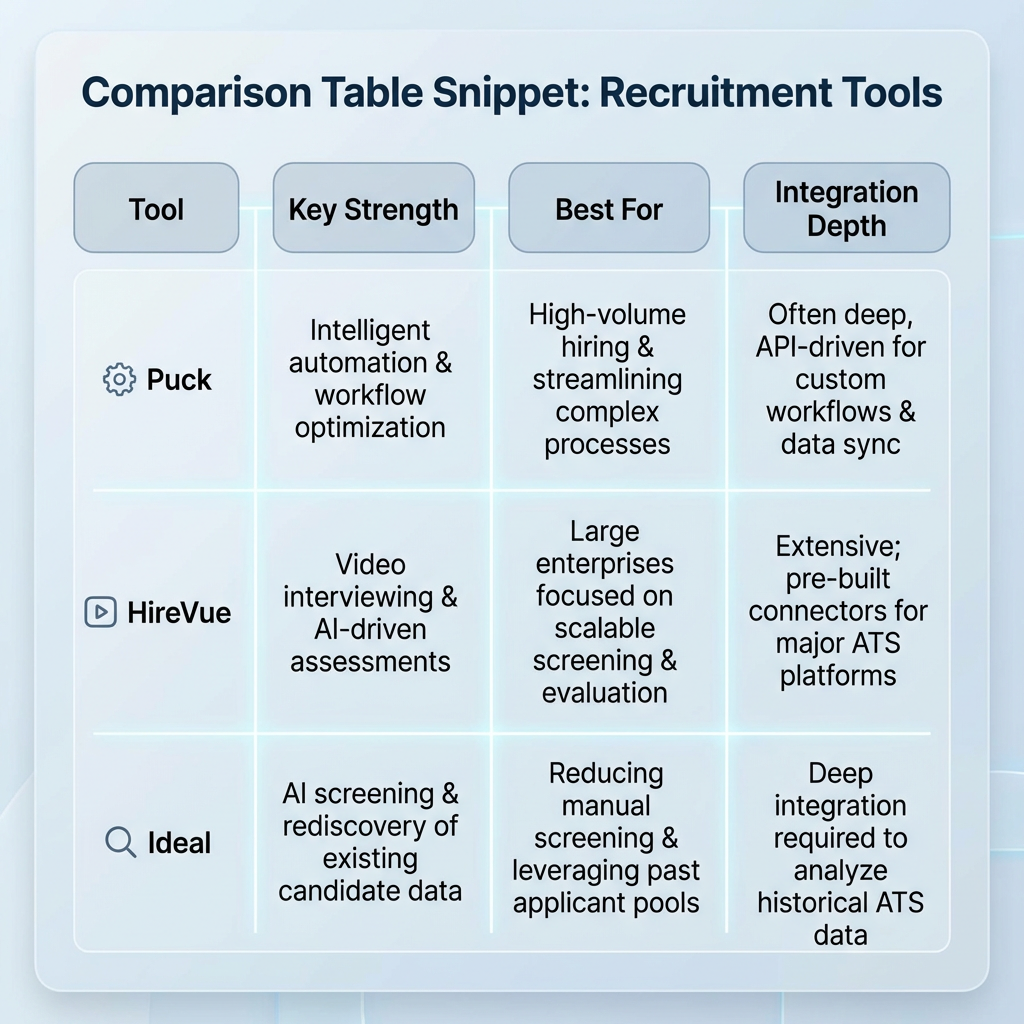
Puck: For modern talent teams and deep AI integration. Puck has emerged as a top choice for companies seeking a modern, user-friendly platform with powerful AI. It excels in parsing accuracy, even with complex resume formats, and offers deep, native integrations with popular ATS and HRIS systems. Its strength lies in providing actionable insights and a seamless workflow for recruiters.
Other Leading Contenders: Features, strengths, and ideal use cases.
- HireVue: Known for its end-to-end platform combining AI screening with video interviewing and assessments. Ideal for companies wanting a unified, high-volume hiring solution.
- Ideal: Focuses heavily on bias reduction and DEI (Diversity, Equity, and Inclusion) metrics, offering robust auditing tools. Strong for enterprises with a dedicated focus on equitable hiring.
- Fetcher (formerly Scout): Combines AI screening with AI-powered sourcing, actively searching for and engaging passive candidates who match your criteria. Best for roles that are hard to fill.
Key Comparison Metrics: Accuracy, integration, bias mitigation, and cost. When evaluating the best AI resume screening software, consider: parsing accuracy rates (ask for a demo with your own resumes), ease of integration with your current tech stack, transparency around bias testing and mitigation features, and the pricing model (per seat, per candidate, or enterprise license).
How to Get Past AI Resume Screening Software: A Candidate’s Guide
For job seekers, the goal is to ensure your resume is seen by human eyes. Here’s your strategic playbook for how to get past resume screening software.
Optimizing for Keywords: Mirroring the job description. Carefully analyze the job description. Identify hard skills (e.g., "SQL," "Project Management"), soft skills ("leadership," "collaboration"), and tools ("Salesforce," "Figma"). Incorporate these keywords naturally throughout your resume, especially in your skills section and bullet points under relevant jobs.
Formatting for Success: Clean, parseable layouts. Use a simple, reverse-chronological format. Stick to standard headings like "Work Experience," "Education," and "Skills." Avoid headers, footers, text boxes, graphics, logos, or complex multi-column layouts, as these can confuse parsing algorithms. Always submit your resume as a .docx or PDF (text-based, not image-based).
Quantifying Achievements for Algorithmic Recognition. Algorithms recognize numbers. Replace vague statements with quantified results. Instead of "Improved sales," write "Increased regional sales by 22% in Q3 2023." This provides concrete data for the AI to assess impact.
Common Pitfalls to Avoid. Steer clear of fancy fonts, submitting your resume as an image file, putting critical information in headers/footers, or using abbreviations the job description doesn’t use. Spell out acronyms at least once.
Choosing the Right Tool: A Buyer’s Checklist
For organizations ready to invest, a structured evaluation is essential.
Define Your Volume and Primary Use Case. Are you screening for 50 roles a year or 5,000? Is your main goal speed, reducing bias, improving quality, or all three? This will narrow the field.
Evaluate Parsing Accuracy and Customization. Request a live parsing demo using a diverse set of resumes from your industry. Can the tool be customized to recognize role-specific skills or your company’s unique competency frameworks?
Assess Integration Capabilities with Your Existing HR Tech Stack. The software must integrate smoothly with your ATS, HRIS, and possibly video interviewing or assessment platforms. Check for pre-built connectors and API flexibility.
Prioritize Tools with Transparent Bias-Auditing Features. Ask vendors how they test for and mitigate algorithmic bias. Do they provide dashboards that track diversity metrics through the funnel? Transparency is non-negotiable for ethical AI use.

The Future of AI in Recruitment
AI screening is just the beginning. The future points toward predictive analytics and skills-based hiring, where AI assesses potential and learned competencies over pedigree. This shift brings critical ethical considerations, necessitating a human-in-the-loop model where AI supports and informs human decision-makers, rather than replacing them entirely. For implementation, start with a pilot program, train your team on how to use and interpret the tool’s outputs, and continuously audit the process for fairness and effectiveness.
Conclusion
AI resume screening software is a powerful force in modern hiring, offering unmatched efficiency and data-driven insights for recruiters while creating a new digital frontier for candidates. By understanding its mechanisms—from parsing to ranking—both parties can engage with it more effectively. For businesses, selecting a tool like Puck or its competitors requires careful analysis of accuracy, integration, and ethical safeguards. For candidates, success lies in strategic optimization. Ultimately, the most successful recruitment strategies will leverage AI’s analytical power while retaining the essential human judgment for making the final, personal connection.