

Introduction
If you want to reduce hiring time, you first need to understand one harsh reality:
Thank you for reading this post, don't forget to subscribe!👉 Top candidates don’t stay available for long.
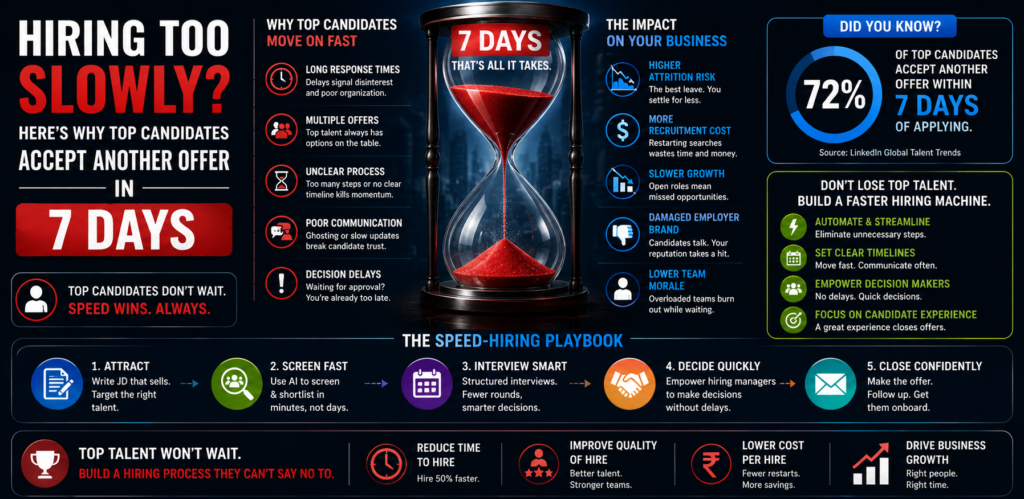
In today’s competitive hiring market, most high-quality candidates accept another offer within 7 days. That means every delay in your hiring process increases your candidate drop off rate.
For startups, SMBs, and even solo HR managers, slow hiring creates:
- Lost candidates
- Poor hiring quality
- Increased workload
- Higher chances of a bad hire
The companies winning today are the ones that can reduce hiring time without sacrificing candidate quality.
Why Hiring Delays Are Costing You Top Talent
Most businesses think candidates are waiting patiently.
They’re not.
The best candidates:
- Apply to multiple companies
- Attend several interviews simultaneously
- Accept the fastest credible offer
If your process takes:
- 10–15 days to shortlist
- Another week for interviews
👉 You’ve already lost them.
This is why businesses must actively work to reduce hiring time.
The Real Cost of Slow Hiring
Hiring slowly impacts more than recruitment.
Hiring delays cause:
- Higher candidate drop off rate
- Increased workload for teams
- Reduced productivity
- Revenue loss from unfilled roles
Most importantly:
👉 Hiring delays damage your employer brand.
Fast Recruitment Process = Competitive Advantage
A strong, fast recruitment process is no longer optional.
Businesses with faster hiring:
✔ Attract better candidates
✔ Improve offer acceptance rates
✔ Reduce recruitment stress
To truly reduce hiring time, companies need:
- Faster screening
- Better shortlisting
- Automated workflows
Resume Screening: The Biggest Bottleneck
The biggest reason companies fail to reduce hiring time is manual resume screening.
Recruiters still rely on:
- Spreadsheets
- Emails
- Basic ATS systems
- keyword-based resume screening
This slows everything down.
Why Keyword-Based Screening Fails
Traditional keyword-based resume screening creates major issues:
- Good candidates get ignored
- Resumes are filtered incorrectly
- Shortlisting becomes inconsistent
This is where:
👉 AI reduces false negatives in hiring
Instead of only matching keywords, AI evaluates:
- Skills
- Context
- Experience relevance
AI vs Traditional ATS
The hiring industry is shifting rapidly toward:
👉 AI vs Traditional ATS
Traditional ATS systems:
- Store resumes
- Track applications
- Depend heavily on manual filtering
Modern AI systems:
✔ Analyze resumes intelligently
✔ Rank candidates automatically
✔ Improve shortlist quality
In the battle of AI vs Traditional ATS, AI clearly helps businesses reduce hiring time more effectively.
Shortlist with AI Screening
Using Shortlist with AI Screening, recruiters can:
✔ Screen hundreds of resumes instantly
✔ Prioritize top candidates quickly
✔ Reduce manual work dramatically
This directly improves your fast recruitment process.
AI Candidate Scoring: Smarter Shortlisting
With AI Candidate Scoring, businesses can:
- Rank candidates objectively
- Match profiles with job roles
- Improve decision-making speed
Understanding how AI works helps recruiters trust the process.
This is one of the fastest ways to reduce hiring time.
Mid-Blog Insight: Why Small Teams Struggle Most
A solo HR manager often handles:
- Screening
- Coordination
- Interviews
- Follow-ups
Without automation, the process becomes overwhelming.
This is why startups and SMBs increasingly rely on:
👉 AI Tools
Modern AI Tools simplify:
- Resume screening
- Candidate ranking
- Shortlist generation
Without needing a large HR team.
BPO Hiring in India: A Perfect Example
In BPO Hiring in India, hiring speed is everything.
Recruiters often process:
- Thousands of resumes
- Multiple openings
- Tight deadlines
Without AI, it becomes impossible to maintain a fast recruitment process.
Bias in Resume Screening Slows Hiring Too
Another hidden issue is:
👉 Bias in Resume Screening
Recruiters may unconsciously prefer:
- Certain colleges
- Familiar companies
- Specific backgrounds
This causes:
- Delayed decisions
- Poor shortlisting
- Higher candidate drop off rate
AI helps reduce this bias through:
✔ Structured evaluation
✔ Consistent scoring
✔ Transparent logic
AI CV Screening Software: The Future of Hiring
Modern AI CV Screening Software helps businesses:
- Screen resumes instantly
- Generate quick shortlists
- Improve hiring accuracy
This is essential for companies trying to reduce hiring time.
Will AI Replace Recruiters?
Many people ask:
👉 Will AI Replace Recruiters?
No.
AI handles repetitive tasks:
- Screening
- Ranking
- Filtering
Recruiters focus on:
- Interviews
- Candidate relationships
- Final hiring decisions
AI improves recruiter productivity—it doesn’t replace recruiters.
Why Bad Hires Increase When Hiring Is Slow
Ironically, slow hiring increases the risk of a bad hire.
Why?
Because when top candidates leave:
- Recruiters panic
- Standards drop
- Decisions become rushed
A faster process improves hiring quality.
How to Reduce Hiring Time Effectively
Here’s a simple framework:
- Step 1: Automate Screening: Use AI CV Screening Software.
- Step 2: Use AI Scoring: Implement AI Candidate Scoring.
- Step 3: Shortlist Faster: Adopt Shortlist with AI Screening.
- Step 4: Reduce Manual Tasks: Avoid outdated systems and spreadsheets.
- Step 5: Move Quickly: Aim to contact shortlisted candidates within 48 hours.
How AI Recruitment Platforms Work in Practice
Instead of relying on manual resume screening, modern platforms use AI to analyze skills, experience, and job fit automatically. Explore the AI hiring features offered by Screlocity to see how intelligent candidate screening helps recruiters identify top candidates faster.
If you’re curious about how AI evaluates resumes and ranks candidates automatically, you can explore the full recruitment workflow in Screlocity’s AI screening process here.
Want to see how AI-powered screening can improve your hiring pipeline? Contact the Screlocity team here to learn how AI recruitment technology can help your organization shortlist candidates faster.
Signs Your Hiring Process Is Too Slow
If your business experiences:
❌ High candidate drop-off rate
❌ Delayed responses
❌ Long screening cycles
❌ Missed top candidates
👉 Please reduce the hiring time as soon as possible..
FAQs + People Also Ask
- Why do top candidates accept another offer quickly?
Top candidates often receive multiple offers and prefer companies with faster hiring processes. - How can companies reduce hiring time?
By automating screening, using AI tools, and streamlining shortlisting. - What is the candidate drop-off rate?
It measures how many candidates leave the hiring process before completion. - How does AI improve hiring speed?
AI automates screening and ranking, reducing manual workload significantly. - What is AI candidate scoring?
It ranks candidates based on skills, experience, and job fit automatically. - Does AI reduce hiring bias?
Yes, AI uses structured evaluation methods to reduce bias in screening. - Is traditional ATS enough for fast hiring?
Traditional ATS systems often lack intelligent screening capabilities. - Will AI replace recruiters completely?
No, AI supports recruiters by automating repetitive hiring tasks.
Final Thoughts
To reduce hiring time, businesses must rethink how they hire.
The old process:
- Manual screening
- Slow shortlisting
- Delayed decisions
No longer works.
Today, speed wins.
Businesses using:
👉 AI screening
👉 Automated shortlists
👉 Faster workflows
Will consistently attract better candidates and reduce hiring delays.
Because in modern recruitment,
👉 the fastest smart recruiter wins. 🚀