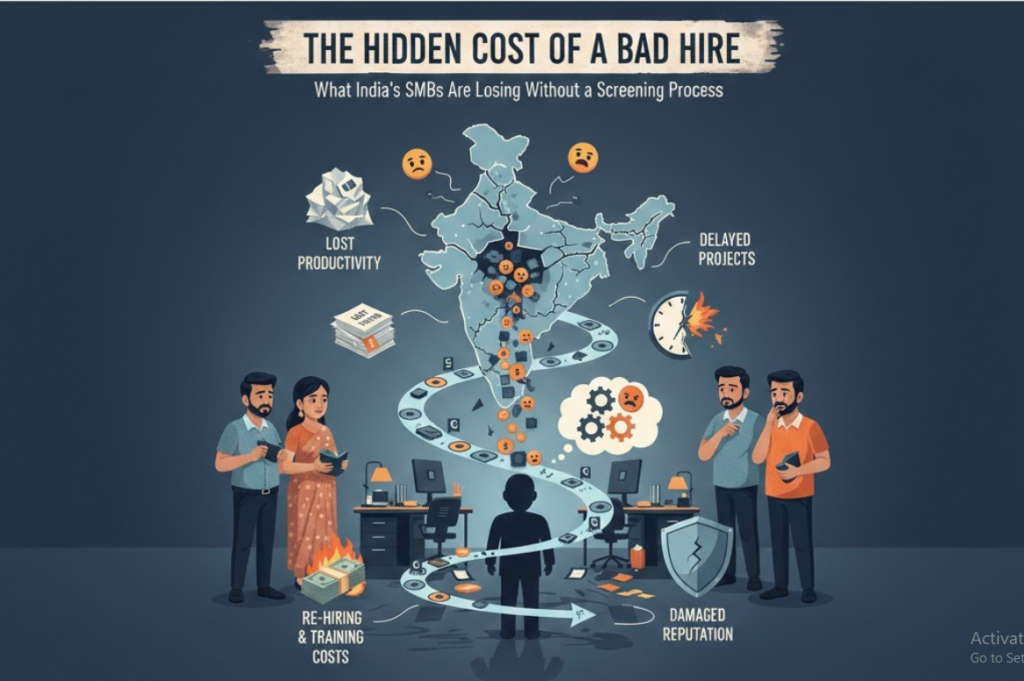


Your job description is the first filter in your hiring process. For most Indian SMBs, it’s broken.
Thank you for reading this post, don't forget to subscribe!It is not broken in an obvious way. Broken in the way that it looks professional, pulls in a hundred applications, and still somehow produces a shortlist where half the candidates have no business being there—and the ones you actually needed never applied in the first place.
The good news: writing a job description that works isn’t complicated. It just requires a different approach than most hiring managers were taught.
Why Most Job Descriptions Fail Before a Single Resume Arrives
The average Indian recruiter manually spends 3 to 5 hours screening a mid-sized application pool. A significant portion of that time is spent filtering out candidates who were never a fit—and who applied because the job description was too broad to signal who the role was actually for.
A bad job description doesn’t just waste your screening time. It actively recruits the wrong people.
Pause and let that sink in.
When a JD is vague, uses generic language, or lists every possible skill “just to be safe,” it casts a wide net—and attracts a wide pool. You’ll get 150 applications. You’ll shortlist 10. Seven of them won’t work out in the first call. The three who might have been right are buried somewhere in a stack that burned out your HR manager before she reached them.
A well-written job description does the opposite: it filters before applications even arrive.
What a Good Job Description Actually Does
Think of your JD as a conversation—not a document. It communicates directly to a certain kind of individual. The result gives them the impression that “this is exactly the role I’ve been looking for.” Moreover, it causes someone else to believe, “I’m not quite right for the position yet.”
Both reactions are wins.
A favorable job description does four things:
- It describes the work, not the wish list. Most JDs list every skill the hiring manager has ever wanted in a candidate. The result is a requirements section that looks like a recruiting fantasy. No single human has managed 5+ years of experience, a postgraduate degree, fluency in three tools, a team leadership background, and a “startup mindset”—all for a role budgeted at ₹6 lakh a year.
Be honest about what the role actually requires versus what would be nice to have. Separate your must-haves from your good-to-haves, explicitly. Candidates read those sections differently.
- It describes outcomes, not just responsibilities. “Manage social media accounts” tells a candidate what they’ll do. The goal is to grow our Instagram following from 8,000 to 25,000 in 12 months by building a content calendar, running paid amplification with a budget of ₹15,000 per month, and managing influencer relationships.
Outcome-oriented JDs attract candidates who are motivated by results—not just task completion.
- It’s honest about the context. Is this a team of two people figuring things out or a structured department with defined processes? Is travel required? Is this a 9-to-6 role or a high-intensity startup environment? Candidates who know what they’re walking into are candidates who stay.
The time you save avoiding misaligned hires is worth more than the applications you might lose by being honest about context.
- It’s specific enough to screen itself. A JD that specifies “experience managing client-facing projects across at least 3 simultaneous accounts” will attract people who have exactly that. A JD that says “project management experience preferred” will attract everyone who has ever managed anything.
Specificity is your first-pass filter. It works before you open a single resume.
Read more about AI resume screening for Indian
The Eight Elements of a High-Quality Job Description for Indian SMBs
Here’s the structure that consistently produces better application pools:
- Role summary (3 to 5 sentences) Who you are, what this role owns, and why it matters. Not a mission statement. Not a corporate paragraph. The paragraph should provide a clear and honest explanation of the actual responsibilities of this person and the purpose of the role.
- Key responsibilities (5 to 7 items): specific actions, not vague accountabilities. “Own the monthly reconciliation process for three accounts,” not “support financial operations.”
- Must-have requirements The non-negotiables. Be ruthless here. If you’d interview someone without it, it’s not a must-have. Every item on this list filters the pool—so only include criteria that genuinely predict success in the role.
- Good-to-have requirements What would make a candidate stronger but wouldn’t disqualify them? This section signals to strong-but-not-perfect candidates that they should still apply.
- What success looks like in 90 days One paragraph. What does a hire need to have done in their first three months for you to call the decision a success? This feature is the single most underused element in Indian SMB hiring.
- Honest context about the role: team size, reporting structure, work style, and pace. One short paragraph. Candidates who read this and think “that’s not for me,” are saving you a round of interviews.
- Compensation range This one is uncomfortable for many founders. Do it anyway. A stated range reduces unqualified applications from candidates outside your band, and it signals respect for the candidate’s time. Approximate ranges work fine—₹6 to ₹8 lakh is more useful than “competitive salary.”
- Clear next step What happens after they apply? When will they hear back? What does the process look like? Candidates who know what to expect stay engaged. Ambiguity causes drop-off—especially among your strongest applicants, who have other options.
How a Better JD Makes Your Screening Process Dramatically Faster
Here’s the connection most hiring managers miss: your job description isn’t just a sourcing document. It’s the foundation of your screening criteria.
When you use an AI screening tool like Screlocity, the JD you upload becomes the benchmark for every resume evaluation. Screlocity reads each application against your JD across six parameters—skills match, experience relevance, education, industry background, keyword alignment, and resume quality—and returns a scored, ranked shortlist in minutes.
The specificity of your JD directly influences the quality of that shortlist.
A vague JD produces a vague shortlist. Screlocity will evaluate what’s in the document—so if your must-haves aren’t specific, the scoring will reflect a wide interpretation of fit, not the narrow, exact match you actually need.
A sharp JD produces a sharp shortlist. When your JD specifies “direct experience managing B2C customer escalations across chat and phone channels” instead of “customer service experience,” the AI scores every resume against exactly that—and your Strong bucket contains candidates who genuinely have it.
The 30 minutes you invest in writing a better JD comes back to you as a 70% reduction in screening time.
Kavya’s Before-and-After
Kavya runs HR for a 160-person D2C homewares brand in Bangalore. They were hiring a Customer Experience Lead—a senior role managing a team of 8, owning resolution quality, and driving an NPS improvement program.
Her first JD was built fast: four bullet points of responsibilities, a generic requirements list, and “competitive salary.” She got 118 applications. Manual screening took a full day. Her shortlist of 8 included two candidates who had never managed a team and one who was a decade more senior than the role warranted.
She rewrote the JD. She incorporated a section on the 90-day outcome. Split must-haves from good-to-haves. The requirements now include a minimum of 5 team members and a minimum of 18 months of team management experience. Added a salary range (₹9 to ₹12 lakh). We removed “MBA preferred” from the must-have section and moved it to the good-to-have section.
Applications dropped from 118 to 73. This resulted in a smaller pool, but one that was significantly improved.
She ran the 73 through Screlocity, which evaluated each resume against her now-specific JD. The process yielded results in less than 20 minutes. Her Strong bucket had 9 candidates—and 7 of them were genuinely interview-worthy on first review. (Figures are illustrative based on similar workflows.)
She made an offer in week four. The hire is still in the role 8 months later.
Common Job Description Mistakes That Hurt Indian SMB Hiring
- Copying a JD from a previous hire or a competitor’s posting — If the role has evolved, the JD needs to reflect the current version, not the last time you hired for it. A JD created for a role 2 years ago will attract candidates for that same role.
- Listing every possible skill as a requirement—”10+ years’ experience preferred” for a ₹5 lakh role signals a disconnect between expectation and reality. Candidates with 10+ years of experience don’t apply. Candidates are hoping you’ll overlook their three years.
- Writing for HR, not for the candidate—If your JD reads like an internal document—formal, third-person, process-heavy—it will fail to attract the candidates you actually want. Write it like a direct conversation with the person you’re looking for.
- Omitting the compensation range—This is the single most common avoidable waste in Indian SMB hiring. Candidates guess. Some guess wrong in both directions. Including a range saves everyone time.
- There is no mention of what makes the role or company captivating. Why would someone want this job? Not in the abstract—specifically. What are they going to build, learn, or own? A candidate with options will read your JD and compare it to others. Give them a reason to be interested.
Publishing before the role is fully defined — A JD written before the hiring manager has clarity on the role produces exactly the wrong kind of inbound. Please ensure internal alignment for the role before proceeding to publish the JD.
Key Learnings
- A job description is your first filter—and most Indian SMB JDs are too vague to filter effectively, which floods the screening stage with unqualified candidates.
- Clearly distinguish the essential requirements from the desirable ones. Every item in your must-have list narrows the pool—include only what genuinely predicts success in the role.
- Outcome-oriented JDs (what does success look like in 90 days?) attract results-driven candidates and set clearer expectations than responsibility lists alone.
- The more specific your JD, the more powerful your AI screening results. Screlocity uses the JD as the benchmark—precision in the JD = precision in the shortlist.
- Publishing a salary range reduces unqualified applicants from outside your band and signals respect for candidates’ time. Approximate ranges work fine.
- A well-written JD takes 30 to 60 minutes longer to write. It saves 3 to 5 hours of screening time and materially reduces bad hire risk on the back end.
The Bottom Line
Most hiring problems in India don’t start with the interview. They don’t start with the shortlist. They start with the job description—a document that is written too quickly, copied from somewhere else, and published before anyone has asked, “Does this position actually describe who we need?”
Fixing your JD is the highest-leverage thing you can do for your hiring process. It costs nothing but clarity and 30 extra minutes of thinking. The return—a better application pool, faster screening, a stronger shortlist, and a higher probability of making the right hire—compounds every time you post a role.
If you’re also using Screlocity to screen, a sharp JD is where the process starts: upload it, connect your folder, and let the tool evaluate every resume against exactly what you’ve defined.
Try Screlocity free for 14 days. And if you want a second pair of eyes on your next JD before it goes live, drop it in the comments—we’d love to help you sharpen it.