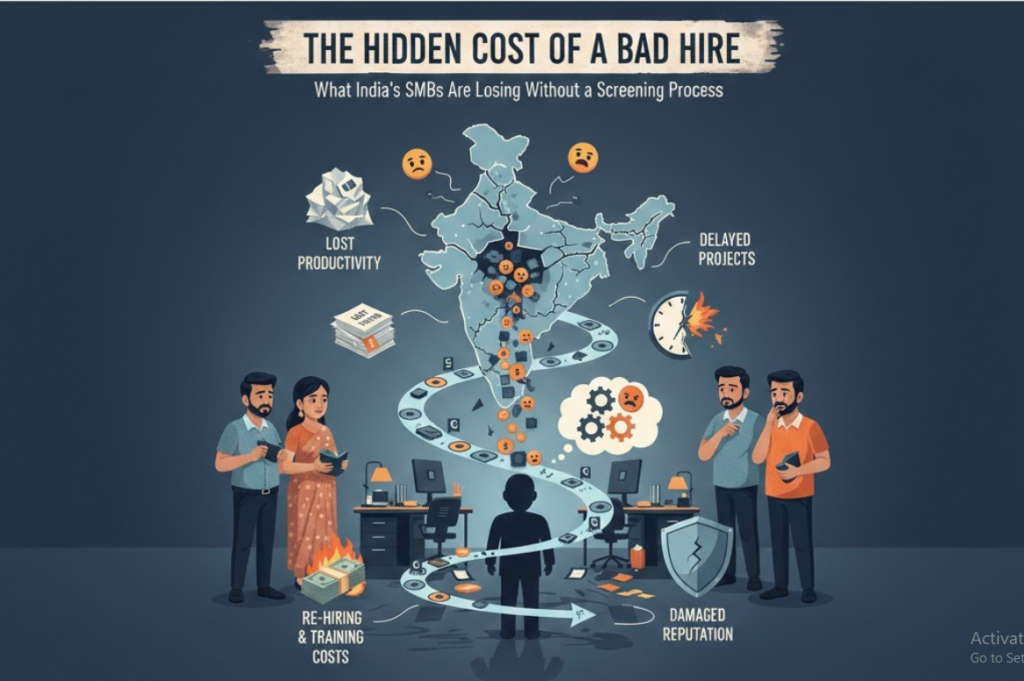


A large enterprise gets 100 applications for an open role. Their system processes the stack overnight, surfaces a ranked shortlist by morning, and the recruiter starts scheduling calls before lunch.
Thank you for reading this post, don't forget to subscribe!An SMB gets the same 100 applications. Their HR manager opens a shared folder, pours a chai, and wonders where the afternoon went.
Same hiring problem. Completely different experience. And the gap has nothing to do with budget anymore.
The difference? AI resume screening for Indian SMBs is no longer an enterprise-only advantage.
The Application Flood Has No Preference for Company Size
Job portals in India have made it easier than ever to apply. A well-placed post on Naukri or LinkedIn can pull in 100–150 applications within 48 hours.
But what happens next determines hiring success.
Large enterprises rely on automation. Today, AI resume screening for Indian SMBs delivers that same structured, consistent evaluation without enterprise budgets.
Instead of spreadsheets and manual filtering, small businesses can now use AI resume screening for Indian SMBs to rank, sort, and evaluate candidates within minutes.
What “Drowning in Applications” Actually Costs You
Let’s quantify it.
Manually reviewing 100 resumes takes 3–5 hours. Multiply that across multiple roles and hiring cycles, and the hidden cost becomes significant.
But cost isn’t the only issue.
Manual screening leads to:
- Decision fatigue
- Inconsistent evaluation
- Missed strong candidates
- Delayed shortlists
This is precisely where AI resume screening for Indian SMBs transforms the process. It eliminates bias from fatigue and ensures every candidate is evaluated using the same weighted criteria.
Instead of spending ₹900–₹4,500 per hiring cycle on manual screening, businesses using AI resume screening for Indian SMBs reduce screening time by up to 75%
How Anjali Levelled the Playing Field
Anjali leads HR at a 230-person BPO in Chennai. Each role attracts 80–120 applications. Her two-person team manages everything from screening to onboarding.
Before automation, screening consumed 18 hours monthly.
After implementing AI resume screening for Indian SMBs, her workflow transformed:
- Job description uploaded
- Resumes auto-scored across six weighted parameters
- Candidates sorted into four actionable tiers
- Plain-language rationale generated for every profile
Now, screening takes under 4 hours per month.
This is the practical impact of AI resume screening for Indian SMBs—faster shortlists, stronger interviews, and higher hiring confidence.
Why AI Resume Screening Works for SMB Hiring
The strength of AI resume screening for Indian SMBs lies in structured evaluation:
- JD-anchored scoring
- Weighted skill and experience analysis
- Role-specific evaluation logic
- Tier-based candidate sorting
- Explainable AI rationale
- Seamless Drive/Dropbox integration
Unlike manual methods, AI resume screening for Indian SMBs ensures repeatable, unbiased, and time-efficient hiring decisions.
The Feature Set That Makes It Possible
- JD-anchored scoring—Your job description sets the standard. Screlocity evaluates every resume against what you actually need, not a generic template of a “good candidate.”
- The system evaluates resumes based on six weighted parameters: skills, experience relevance, education, industry background, keyword alignment, and resume quality. Each one is weighted by importance, not averaged into a flat score.
- Role-intelligent evaluation—A sales role and an operations role need different evaluation logic. Screlocity adjusts scoring weightages by function, so the right things carry the right weight.
- There are four candidate buckets: strong, moderate, weak, and rejected. You know immediately where to focus and what you can safely deprioritize.
- Plain-language AI rationale—Every score has an explanation you can act on and share with stakeholders. No black boxes. No blind trust required.
- Google Drive and Dropbox integration—Resumes land in your folder. Results appear in categorized subfolders. Your existing workflow stays exactly as it is.
- The system operates independently, eliminating the need for an HRMS. No implementation timeline. Start with your next hiring round.
Mistakes That Deepen the Volume Problem
- Writing a JD that attracts everyone—A broad, feature-list JD gets broad, unfiltered applications. Writing a vague JD quickly pays off (with interest) during screening. Specificity at the front saves hours at the back.
- A linear review of the full stack—reading 100 resumes from number 1 to number 100—applies your sharpest judgment to whoever happens to apply first. A tiered approach—strong first, then moderate—is faster and smarter.
- Interviewing from the Moderate bucket without a clear filter—Moderate candidates need a specific reason to proceed to an interview, such as being a good fit. Know what additional signal you’re looking for before scheduling the call.
- Letting applications age without communication—Every day a strong candidate waits without hearing from you, they’re advancing in a process somewhere else. Fast, consistent first-pass screening directly improves your offer acceptance rate.
- Using inconsistent criteria across hiring rounds—If you hire for the same role three times a year and assess it differently each time, your quality bar is invisible and your shortlists are incomparable. Build repeatable criteria or use a tool that applies them automatically.
Implementing AI resume screening for Indian SMBs prevents these inefficiencies by creating a standardized, fast first-pass screening system.
Key Learnings
- Getting 100 applications is the good news. The challenge is evaluating them consistently, fairly, and fast—something manual review doesn’t do reliably.
- Manual screening of high-volume applications costs ₹900 to ₹4,500+ per hiring cycle in labor time—a recurring, largely invisible cost for SMBs that hire regularly.
- The AI screening tools that large enterprises have used for years are now available to Indian SMBs at ₹490/month with no HRMS required.
- Screlocity evaluates every resume against your JD across six parameters, returns results in minutes, and sorts candidates into four actionable tiers.
- Role-intelligent scoring means the criteria for a customer service role and a technical operations role are not evaluated with the same weights.
- Plain-language rationale for every candidate score means your shortlist is immediately explainable—to hiring managers, to yourself, and to candidates who ask.
The Bottom Line
The enterprise advantage in hiring was never headcount or budget. It was systems—specifically, consistent, fast, first-pass screening that doesn’t depend on one person’s energy level on a Wednesday afternoon.
That system is now yours.
Indian SMBs have been playing a volume game with manual tools for too long. Screlocity was built for exactly this situation: meaningful applicant volumes, lean HR teams, and a need for shortlists that hold up under scrutiny.
Try it free for 14 days. Run your next 100-resume hiring round through it and compare the results—in time, in quality, and in how it feels to walk into a shortlist review with documented reasoning behind every call.
What does your current 100-resume process look like? Drop a comment—we’d love to hear where the hours are going.
Click here to check your resume: Screlocity