

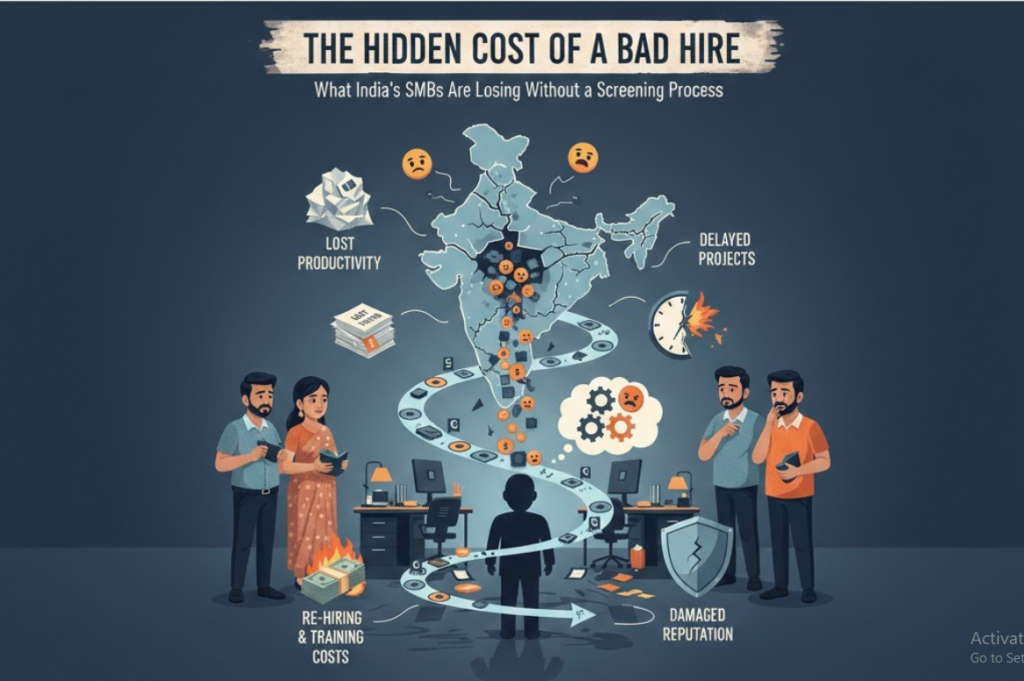
A bad hire costs you between ₹3 lakh and ₹10 lakh. Most SMBs in India have no idea.
Thank you for reading this post, don't forget to subscribe!That number sounds dramatic. It shouldn’t. Once you add up the salary paid during the notice period, the time your team spent onboarding someone who didn’t work out, the productivity gap while the role sat unfilled again, and the cost of running the entire hiring cycle a second time—₹3 lakh is actually conservative.
The worst part? Most bad hires are preventable. And the prevention doesn’t start at the interview stage. It starts at first-pass screening.
What a Bad Hire Actually Costs an Indian SMB
Let’s break down where the money goes. These figures are illustrative, built on typical SMB salary ranges and hiring timelines in India.
Direct costs:
- Salary paid to the wrong person—A mid-level hire at ₹5 lakh per year, employed for 3 months before the fit problem becomes undeniable—costs ₹1.25 lakh in salary alone.
- Recruitment costs (round one)—Job portal listings, recruiter time, and interview coordination. For an SMB without an agency, this is largely internal time. At ₹300 to ₹400 per HR hour across 10 to 15 hours, that’s ₹3,000 to ₹6,000 per role.
- Onboarding and training investment — Time from your team leads, access provisioning, and documentation. This process typically requires 2 to 4 weeks of part-time attention from at least two people. Conservative estimate: ₹15,000 to ₹30,000 in combined team time.
- Rehiring costs (round two)—You’re now running the entire hiring cycle again, often under more pressure and with a wider gap in your team.
Indirect costs (harder to quantify, impossible to ignore)
- Productivity drag on the team—A bad hire doesn’t just underperform. They create work for the people around them. Re-doing their outputs, covering their responsibilities, managing the friction—these costs are real and spread across multiple salaries.
- Hiring manager fatigue—Every hour a hiring manager invests in interviewing, onboarding, and managing out a bad hire is an hour spent away from the work they’re actually accountable for.
- Morale impact—Teams notice when a poor fit stays too long. High performers notice faster. The ripple effect of a bad hire on team culture is one of the least visible and most expensive outcomes.
Pause and let that sink in.
A single bad hire at the mid-level in an SMB can realistically set you back ₹3 to ₹6 lakh—and that’s before you account for the opportunity cost of the role being empty or underperforming for 4 to 6 months.
Read more about AI resume screening for Indian
Where Bad Hires Actually Come From
Contrary to popular belief, poor interviews are not the primary cause of most bad hires. They’re caused by poor shortlisting.
By the time a candidate sits across from you in an interview, you’ve already invested significant time and implicit trust in them. There’s a natural bias toward finding a way to make them work. The interview is where you assess fit, personality, and depth—but it’s not designed to catch the surface-level mismatches that a proper screening process would have flagged much earlier.
When first-pass screening is rushed, inconsistent, or simply absent, the wrong candidates reach the interview stage. And once they’re in the room, several things work against you:
- There is a cognitive bias towards candidates who are already in the pipeline. You’ve already spent time on them—that investment primes you to see them more favorably.
- Overweighting presentation. A confident, well-spoken candidate can sail through an interview, while a quieter but stronger candidate gets filtered out. Without objective screening data backing up your interview, this bias is almost impossible to avoid.
- There is a constant pressure to fill the role. When a role has been open for three weeks and your hiring manager is following up daily, the bar for “good enough” shifts. A weak shortlist, produced by weak screening, forces you to compromise more often.
- There is no established benchmark for comparison. In a properly screened process, your interview pool is already filtered to candidates who meet defined criteria based on skills, experience, and relevance. The interview is calibrating personality and culture fit within an already-qualified pool. Without that baseline, the interview is trying to do two jobs at once—and doing neither well.
Rahul’s ₹4 Lakh Lesson
Rahul runs a 90-person cloud kitchen operation in Bangalore. He was scaling quickly and needed a City Operations manager—someone to oversee 3 kitchen locations, coordinate logistics, and manage a team of 25. He got 85 applications, shortlisted 8 based on a quick read-through, interviewed 4, and hired one.
Three months later, the hire wasn’t working. Deliveries were inconsistent, team complaints had increased, and two of his kitchen leads had quietly started looking elsewhere. He let the hire go, absorbed the exit period, and relaunched the search.
Rahul put the total damage at roughly ₹4.2 lakh—accounting for four months of salary, re-recruiting costs, the time his COO spent managing the fallout, and the partial churn of one kitchen lead who left while the role was in flux.
His diagnosis, after the fact: the original shortlist never properly evaluated whether candidates had managed multi-location teams. A quick read-through of 85 resumes, done in an afternoon under pressure, had prioritized food industry experience and job titles over the specific operational complexity he actually needed.
He now uses Screlocity. Every new JD specifies multi-location team management as a weighted parameter. The shortlist he gets back is evaluated against that criterion before anyone reaches the interview stage.
His last hiring round for the same type of role: 78 applications, screened in under 30 minutes, a strong shortlist of 7. The hiring process took place within a span of three weeks. He remains in the role six months later. (Figures are illustrative based on similar workflows.)
Read more about How to Write a Job Description.
How a Screening Process Blocks Bad Hires at the Source
A proper first-pass screening process doesn’t just save time. It protects the integrity of everything that comes after it.
Here’s what changes when screening is structured and consistent:
- The interview pool is already qualified. Every candidate who reaches your hiring manager has been evaluated against defined criteria—not just “looked good on a quick read.” The interview can focus entirely on fit, depth, and judgment.
- Bias has less room to operate. When every resume is evaluated on the same parameters at the same weights, the idiosyncrasies of whoever happened to be reviewing resumes on a given afternoon don’t determine who makes the shortlist.
- You can defend every shortlisting decision. When a hiring manager asks “why isn’t this person on the list?” the answer is, “their experience relevance scored Weak against the JD parameters—specifically, no direct experience managing distributed teams.” “That’s a conversation, not a guessing match.
- The pattern of undesirable hires becomes visible. If you’re using a consistent screening framework, repeated negative hires tell you something about your JD, not just your luck. You can diagnose and fix the screening criteria rather than rerun the same broken process.
How Sclerocity Addresses the Root Cause
Screlocity is an AI-powered screening tool designed specifically for Indian SMBs. Upload your job description. Connect your Google Drive or Dropbox folder where applications land. Screlocity evaluates every resume against six parameters—skills match, experience relevance, education, industry background, keyword alignment, and resume quality—and returns four-tier sorted results in minutes: Strong, Moderate, Weak, and Reject.
Every candidate gets a score. Every score gets a plain-language rationale.
The shortlist you bring to the interview stage is already filtered on documented, consistent criteria. Not a gut feeling. The selection process is based on documented, consistent criteria, not on who happened to stand out during a two-hour afternoon session. A transparent, reasoned evaluation of each applicant is conducted against the role you actually need to fill.
At ₹490/month, preventing even a fraction of one bad hire per year pays for the tool many times over.
Screening Mistakes That Create Bad Hire Risk
Treating the JD as a formality—a vague job description pushed out quickly to get applicants moving—generates an unfiltered pool. The less specific the JD, the harder the screening—and the higher the bad-hire risk.
- Speed-reading resumes under pressure—When a role has been open too long and stakeholders are pushing, screening quality drops. The compromise is almost never visible until 3 months after the hire.
- Using gut feel as a primary filter—”Something about this one felt right” is a legitimate final input. It shouldn’t be the first one. Gut feeling as a first-pass filter systematically overselects candidates who present well on paper, not those who fit the role.
- Skipping the structured shortlist entirely — Some founders interview everyone who looks “interesting” without a structured first pass. This burns interview time, exhausts hiring managers, and produces inconsistent outcomes.
- Not post-morteming bad hires—If a hire doesn’t work out and your only response is to start screening again, you’ve missed the feedback. Could we explore what might have been overlooked in the original shortlist? What criteria weren’t in the JD? That information prevents the next one.
Key Learnings
A bad hire at the mid-level can cost Indian SMBs ₹3 to ₹6 lakh when direct, indirect, and rehiring costs are fully accounted for (illustrative estimate).
Most bad hires are rooted in poor shortlisting—not poor interviews. The interview stage inherits the mistakes of first-pass screening.
Inconsistent, rushed, or gut-feel-driven screening systematically introduces unqualified candidates into your interview pipeline.
A structured screening process—with defined criteria, consistent evaluation, and documented reasoning—reduces bad hire risk at the source, not after the fact.
Screlocity evaluates every resume against your JD across six parameters and returns a ranked, rationale-supported shortlist in minutes—giving your interview stage a qualified, defensible pool to work from.
At ₹490/month, one prevented bad hire covers years of the subscription.
The Bottom Line
The cost of a bad hire isn’t bad luck. It’s a process gap—usually traceable to a first-pass screening stage that was skipped, rushed, or run on gut feeling under pressure.
Indian SMBs hiring without a structured screening process aren’t just losing time. They’re building compounding risk into every hiring cycle: inflated costs, weaker teams, slower growth, and a hiring loop that resets every time the wrong person doesn’t work out.
Screlocity was built to close that gap—not with a complex HRMS rollout, but with a lightweight, plug-and-play tool that brings objectivity, speed, and transparency to the one stage that prevents bad hires before they happen.
Try it free for 14 days. Please upload your next JD to experience the benefits of structured screening.
Have you encountered a costly hiring experience? Drop it in the comments—we’d love to discuss what went wrong and how to prevent it next time.